
WORDS OF THE TWO COUNTRIES IN ONE DICTIONARY
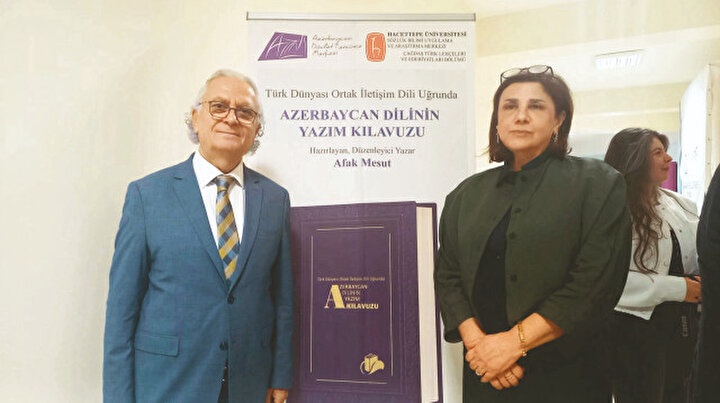
Last year the book Spelling Dictionary of the Azerbaijani Language for the Common Means of Communication in the Turkic World was published in Turkish as a contribution to those interested in the Azerbaijani language and literature.
Due to the ever-expanding communication with Türkiye held by the Azerbaijan State Translation Centre over the past few years, the book with new Turkish words added was presented at Hacettepe University. It should be noted that the preparation of this dictionary is an important and exemplary step in the development and expansion of the common communication language of the Turkic world. The dictionary includes such words, as “bilinc”, “çarşı”, “doğal”, “kürəsəl”, “olqun”, “seçmən”, “sınır”, “tutqu”, “uçaq”, which have become widely used in the Azerbaijani language. The book published by “Erkmen” Publishing House consists of 904 pages.
By stating that the language is the most important factor representing the unity of the two states, Afaq Masud, the author-compiler of the Spelling Dictionary of the Azerbaijani Language, emphasized that it would be easier to read and understand the literature of the two countries through this dictionary. Afaq Masud: “There are too many expressions that had been borrowed from different languages into our language. While compling the dictionary, we tried not to use such words, and foreign words were replaced by our native expressions. Common expressions of the Turkish and Azerbaijani languages, as well as our forgotten ancient words, have been included in the dictionary. This book is the mirror of our language.” Professor Shukru Haluk Akalın, the author of the foreword, stated that the book would serve as an example for the Turkic world: “One of the most important features of the dictionary is the inclusion of words and expressions from the Turkic world, mainly from the Turkish, in the Azerbaijani language. This dictionary is an important and exemplary guide aimed at the development of a common language of communication and its spreading in the Turkic world.”